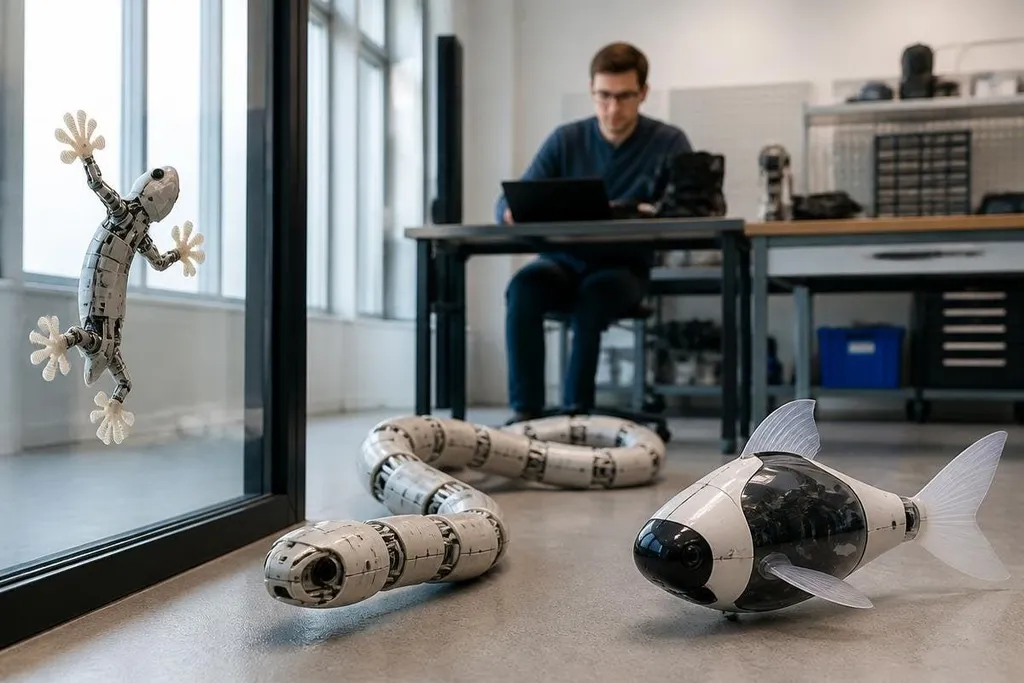
A gecko can climb smooth glass, a snake can move through narrow gaps, and a fish can turn without a rigid axle. Engineers study those movements because each one solves a problem that wheels, tracks, or stiff arms handle poorly.
This matters when you need a robot to cross loose ground, inspect a pipe, or move safely around people. Animal-inspired design gives engineers tested physical ideas, but it also brings new control and maintenance problems.
- Gecko feet use many small contact points to grip smooth surfaces.
- Snake bodies spread motion across many joints, helping robots enter narrow spaces.
- Fish tails move water with less rigid hardware than a fixed thruster system.
Feet that grip without heavy clamps
Gecko feet show how surface contact can replace large motors and clamps. Tiny structures on each toe create many points of contact, producing grip through weak forces that add together.
A climbing robot can copy this idea with dry adhesive pads or small hooks. The design may help it inspect glass, painted walls, or metal tanks without drilling holes or carrying a magnetic system.
The surface still matters. Dust, rough paint, moisture, and damaged panels can reduce grip, so a robot must check its contact before it moves its full weight. A failed foothold can drop the robot, its camera, and the repair bill together.
Snake bodies spread the work
A snake moves by sending waves through its body. Each section pushes against the ground, then passes motion to the next section. A snake robot uses many connected joints to copy that pattern.
That layout helps in pipes, rubble, and other spaces where a wheeled robot may lose contact. The robot can bend around a corner while keeping several body sections against the surface, which helps it carry a camera or sensor through a long passage.
The tradeoff is control. A robot with many joints needs more motors, cables, sensors, and software. Operators may also need a clear view of the whole body because the front camera cannot show what the rear sections are doing.
A fish-like body shifts control into flexible motion, while a bird-like robot must change lift and balance as it moves. The examples need a named machine and a recorded task, not a shape that only looks right in a lab video. A dated Robot 24 report can give you that reference before the next section compares how fish and birds move.
Fish and birds change how robots move
Fish use flexible bodies and fins to move water. That approach gives underwater robots quiet movement and fine control at low speed, where a rigid thruster can create unwanted flow near a camera or sensor.
Bird wings offer another idea: lift comes from changing the shape and angle of a moving surface. A drone with flapping wings can copy that motion, though small motors and light materials must survive repeated loads.
These designs make sense when the environment rewards quiet motion or tight turning. They don't replace mechanical thrusters and rotors for every job. A fish-like robot may move well in water but struggle with batteries, waterproof joints, and recovery after a motor fault.
What animal designs still leave open
Animal movement looks simple from a distance. The machine has to measure contact, estimate its body position, and change motor force many times each second. A useful design needs more than a shape that looks like a leg or fin.
I’d judge an animal-inspired robot by the task it completes, not by how closely it copies the animal. A four-legged inspection robot needs stable walking and safe recovery; it doesn't need to reproduce every detail of a dog's gait.
Before choosing a design, use this check:
- Name the obstacle: loose soil, water, stairs, pipes, or smooth walls.
- Set the payload: include the camera, battery, cable, and protective housing.
- Check contact loss: see how the robot reacts when one foot, fin, or wheel slips.
- Count moving parts: more joints can improve movement but add failure points.
- Test recovery: confirm that the robot can stop safely and return to a service area.
Animal-inspired robots work best when the copied mechanism answers a specific engineering need. The next useful test is clear: can that mechanism keep working after dust, water, low battery power, and a full day of repeated motion?